
We want you to have the best chance of your story being accepted into the archive, and of being appreciated by archive readers. The following suggestions are to help you write stories we can accept, to make the most of your writing and make it as readable as possible.
If you have questions or need clarification on policy, email us at the admin address below, or ask in the New MMSA forum.
If you are already an archive author, you may continue on to submit a story...If you take care over the presentation of your story, people will find it easier to read. They will appreciate it better and are more likely to reach the end of it rather than clicking on to something else in frustration. That means you have more chance of receiving recommendations and readers will remember your stories next time they visit the archive. They are more likely to read something by you again if they found the last story enjoyable in style and presentation, not just content.
Readability includes the obvious things like correcting spelling mistakes and grammatical errors, as well as less obvious things like good layout, such as separating paragraphs and story sections properly. Stories without enough white space are not inviting to the eye and are often difficult to follow. A page of text without paragraphs is very daunting and readers may simply click on to something else rather than wade through dense passages with no chance to mentally breathe occasionally. Too much white space (eg. double-spaced paragraphs) is also poor.
We have taken great care over the site design to make it as readable as possible, with simple high-contrast colouring, a clear sans-serif typeface in a legible size, good page margins, adequate line spacing and as little page clutter as possible. We are trying to make your stories look their best – shouldn’t you?
A well-written story engages the reader in your tale, encouraging them to suspend their disbelief and be immersed in your fantasy. If the story contains glaring mistakes, that fantasy is shattered and the reader finds themselves frustrated and focussed on processing the text in front of them, not on the story you are trying to tell. You want to keep them concentrating on the story, not continually having to decipher your words or meanings.
Spelling is easily checked in most word processors. Granted, it won’t help you fix odd slips with homonyms like
bear bottom
when you meant bare bottom
! But it should be standard practice to proof-read
your story carefully BEFORE you submit it for others to see. You might ask another author here to check it out as an
editing buddy or, if you cannot find someone, another useful tip is to print it out on paper from your word processor.
For some reason, the eye is much better at finding mistakes in printed type rather than on-screen, and you’ll
catch many more simple typing errors that way.
Grammar is more subjective, and grammar checkers in word processors are not totally reliable. But the important thing to remember is that what you should be submitting here is CREATIVE WRITING. The sort of shorthand you might use in email or other web situations, without full sentences, punctuation or proper capitalisation, is NOT what readers want to wade through. That will not encourage them to enter into the fantasy you are trying to create and enjoy it with you.
CREATIVE WRITING means there also has to be more to a story than: I am 13... He said to me... I said
to him... I bent over... He whacked me... The End.
There has to be some proper characterisation, setting,
description, and some exploration of emotions and feelings beyond: It hurt... OW!
It does take more time and effort to write properly and check your work thoroughly. But it’s not a waste of time, it’s simply treating your readers with respect by making a minimal effort to write correctly. After all, those readers don’t want to feel they have wasted their time reading your story! The more readable it is, the more likely that they will bother, and try something by you again in the future. And you will have a greater sense of achievement at the end, and get more feedback and recommendations from happy readers. Everyone wins!
No! It’s not our responsibility to edit your stories, it’s yours to make them fully presentable in the first place! If you want advice, or help, you can try asking in the New MMSA forum. There are some readers and reviewers willing to help well-intentioned authors with formatting and style.
Due to abuses in the past, we regret that we are now taking a much stronger line on both formatting and fundamental grammar/content issues in submissions. We expect authors to respect both our site and readers by conforming to normal rules of sentence structure and punctuation. We therefore reserve the right to refuse submissions that exhibit substantial problems with formatting, basic grammar or content deficit. In this case we will advise you and suggest revisions, to allow you to edit/update your story before we will approve it.
In the future, changes may be made that improve layout, or the way they display in a web browser, and we may also take the opportunity to fix minor mistakes in spelling and grammar that are detected during or after approval, where those impact the readability of your story. This is intended only as a beneficial service to authors and such changes will not alter the wording or meaning of your stories. They will be notified to you where possible.
Yes! We already mentioned the importance of including enough paragraph breaks, or white space. Always make sure that your paragraphs are separated by at least one blank line, so that when your story is converted to HTML the software can recognise where they start and finish. Without paragraphs, the reader cannot easily separate different ideas or events as they occur and may get confused by who is doing what and when.
One good example of this is speech – it’s very good form to make a paragraph change when the speaker changes, ie. two quotes from two different speakers should NOT be included in the same paragraph. For instance, the following is correct:
Ow! That hurt,
said Jim.
His dad chuckled. That’s the idea!
But this is much less readable and it’s easier to misread who is saying what at the end:
Ow! That hurt,
said Jim. His dad chuckled. That’s the idea!
The above snippet also shows the correct way to put punctuation around quoted speech, often misunderstood. Incorrect punctuation (and capitalisation) is the most common error in stories, and is a sure-fire way to make it hard for readers to understand where your sentences start and end, and which characters are speaking. Thanks go to author Harmony for the following useful guidelines posted inthe MMSA forum.
When a complete sentence is quoted, ending full stops (or periods, as we Yanks call them) always go inside the quotes. If there’s a tag line (eg. he said) after the quote, then at the end of the quoted sentence there should be a comma rather than a period:
Good morning, boys,
the headmaster said.
If the quote is at the end of the sentence, it ends in a period, which goes inside the quote. And you would put a comma [or maybe a colon for preference] after the tag that introduces it, although if you’re using some sort of gesture or action to indicate the headmaster is talking, rather than a he said type tag, then you’d write it as two separate sentences:
The headmaster said, Good morning, boys.
The headmaster began: Good morning, boys.
The headmaster held up his hand for silence. Good morning, boys.
With exclamation points and question marks, they go inside of the quote if they’re part of the quote, or outside of it, if the quote itself is part of the question or exclamation. Examples:
The headmaster asked, Isn’t it a lovely morning?
Do you think it’s a lovely morning?
the headmaster asked.
Didn’t he say, It’s a lovely morning
?
From the above examples, there are two other important things to note. The first is that the quoted speech ALWAYS begins with a capital letter even in the middle of a sentence, if it is the start of a spoken sentence. The second is that generally only ONE punctuation mark is required. It is incorrect to put a full stop inside the quote followed immediately by another (or a comma) outside. The one inside the quote closes both the inner and outer sentences. However, as the exception to this rule we mustn’t forget the possibility of a question inside a question (and embedded exclamations):
Why did John ask: Where is it?
?
Why did Peter reply: Here it is!
?
While on the subject of quotes, we have full support for smart quotes in stories submitted in all formats. For these to be recognised correctly, you MUST use THE SAME – DOUBLE – quote marks for ALL speech quotes in a quoted passage, even if you normally prefer single quotes, and even if the speech is nested within another quote. This will be automatically fixed when a story is viewed to produce the correct style (in this case for English language) modified by your personal preferences:
He told me
Tom grimaced.
Trousers and pants down,
and I got it bare bum!
Note how the inner quotes there are single. It is typographic convention that nested speech quotes alternate between single and double at every level, however deep, but as long as you ALWAYS use double quotemarks everywhere when you submit, the site parser and your browser will take care of displaying it correctly like this for you.
If you use single quotemarks around a phrase, those will be recognised and treated differently by the site parsers from speech quotes. These are considered emphasis quotes, where the words are anything that is not speech (meaning words spoken aloud by someone or something). That could be the text of a note or sign or a newspaper article, a title or other special emphasis, or where the highlight shows irony/sarcasm. Unlike speech quotes, these emphasis quotes are always shown in single quotemarks on the site:
Keep off the grass! said the sign.
I read the headline: PM calls for new taxes.
The article definitely spoke to me.
The music was classical in style.
The music was painful to listen to.
Quite apart from the issues of grammar, the use of quotes on the site is technically complex, as we now employ the HTML <q> and <em> tags to mark them up and render the punctuation. This will be of most concern, or interest, if you are submitting in HTML rather than RTF or text, but it can also create some unexpected gotchas for authors writing with certain speech styles, where words are fore-shortened like ’til (for until) and ’em (for them) with apostrophes. We therefore STRONGLY advise that you read our full HTML reference guide for MMSA for more information, especially for discussion of the tags which we allow on the site.
Otherwise, if you are not writing in HTML, here is a quick summary of the most important things you need to know about quotes when posting stories here:
Finally, here’s some advice about breaking up stories into segments, maybe taking place at different times or places or from different character viewpoints. A common way to do this is to put a separation line (usually centred) of dashes, stars or other symbols between the segments. A regular mistake though is to assume that the person reading the story will have the same page-width as you, and to make the line very long to fill the width of the word processor window you are writing it in.
This creates a problem with webpages because the browser is not allowed to break a long line without any spaces or hyphens, and so it forces the story to have a horizontal scrollbar and not to reflow correctly when the browser window width is changed. If you use separator lines in your story, please make them VERY short so that this is avoided. If you are writing in HTML then you may use the HTML <HR> tag to give a centred and well-indented horizontal rule. More interesting section separator options may be made available in future.
You can post a story using one of three formats: plain text, Rich Text Format or HTML. Plain text has no formatting and is output by basic text editors like Windows Notepad. Rich Text Format allows very complex formatting and is output by fully featured word processors like MS Word and WordPerfect, or more basic free ones like Windows Wordpad. HTML (Hypertext Markup Language) is what is understood by your browser and is what web pages are written in. Your story will get converted by us automatically to HTML, or used directly –with validation and formatting improvements – if that is what you posted it in.
If you post in plain text, you will not be able to add any style formatting. You would need to mark up the text properly into HTML with the correct tags. If you want to do that, you should be very familiar with HTML – there are thousands of tutorials on the web that will give you the basics you need. This site supports a reasonable subset of simple style tags and within the site limits HTML gives you great control over the way your story looks. You can always edit the HTML source we store of your stories directly too. We recommend that you read our full HTML reference guide for MMSA for details.
For most people it is much easier though to use any simple word processor and to add your formatting there. You will need to export the finished document in Rich Text Format (RTF) rather than saving in your word processor’s proprietary format, as we cannot accept files saved like that. Rich Text is a common interchange format supported by all word processors – instead of selecting Save from your File menu, choose Save As... and you should be able to select RTF as the export file type in the save dialog:
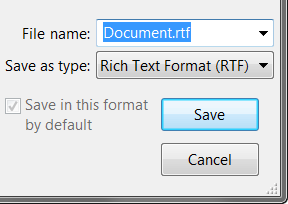
Whatever format you choose to submit in, you can upload your file directly using the submission page browse box and the formatting you added should be converted correctly.
But be careful how you use formatting effects. If you read a book you will see hardly any in the main text, for good reason. Bold is best used only for headings if at all. Italics are useful for occasional emphasis, words in a foreign language, changes of story viewpoint (eg. flashbacks, another character’s view or author interjections) or character thoughts rather than actual speech. Like any formatting, though, it is best used sparingly as it can distract the eye and disrupt the reader’s concentration.
This archive supports and promotes best grammar practices in order to educate and to maintain good literary standards, in an age when they are being increasingly challenged and debased by widespread misuse in digital media. Addressing standards is not elitism – it is a matter of preserving national and cultural identity while correcting misapprehensions and assumptions that take root where writing and basic literacy is no longer effectively reinforced at the school level in some countries.
Related to this, there has been a robust debate among authors over the use of anymore. Because various online dictionaries state vaguely that the word is a valid synonym for any more, especially in US English, this has been mistaken by some to mean that all usage of it is acceptable. While language does inevitably change over time (we no longer write in Chaucerian English, for instance), this site now has a policy on the word that is informed by at least two respected dictionary references: Cambridge and Merriam-Webster.
Firstly, this site does NOT accept that the word is acceptable in British English. It is entirely an American construct, like the alternative US spellings of honor, color, realize etc.. Where it is used in stories with a British setting and dialogue, the word is a misspelling and will be treated as such by the automatic site parser to remove incorrect US idiosyncrasies from UK stories.
However, for US authors and US-set stories the message from the above dictionary authorities is clear: where anymore is used in an adverbial sense, usually relating to time, it is correct as a colloquial alternative to any more. That does NOT mean that any more is therefore incorrect in US English. Importantly, the logical flipside of that very specific usage advice is that where it is used as an adjective, not an adverb, then anymore is grammatically INcorrect. In addition, indiscriminate use of anymore without regard to whether the sense is adverbial or adjectival may in fact produce a meaning that you do not intend, so we are recommending and ensuring that it should be handled with care by authors.
Because this is a complex issue, here are some examples to consider. Remember that adverbs are descriptive modifiers for verbs (doing words) whereas adjectives are descriptive modifiers for nouns (words referring to things). Sometimes the noun or verb may not be present in a sentence even though it is implied.
Typically the adjectival usage, for which anymore is incorrect, would be in the form:
any more than [something]
any more of [something]
any more [something(s)]
Therefore, in these sentences, you MUST NOT use anymore:
Any more of that noise and I’ll get angry.
We didn’t have any more milk in the fridge.
Can you give me any more information?
I can’t give you any more than that.
I can’t take any more.
Compare the last two: despite an apparently missing noun object, the final one is definitely not adverbial. You
could also write any more of that, or just more (used as a noun), so any there is just a
simple adjective for more, just as much would be if you had written: I can’t take
much more.
The word juxtaposition is coincidental.
Where anymore is acceptable in US English is in adverbial usages, with a time-related meaning of permanently from now on:
We don’t go there anymore.
All I want to do anymore is...
I don’t care anymore.
Where we urge caution about using anymore indiscriminately is when the usage can change the meaning of the sentence. If you can rewrite or add words that show it is really being used as an adjective, then you MUST certainly use any more instead. Choice of language should always be made to communicate your meaning clearly, and using ambiguous or incorrect choices can misdirect the reader. Here are some useful examples to consider, which hopefully show clearly why assuming anymore is always right is a BAD idea. Context and meaning are everything:
I don’t want to hear any more
[of that – adjective, noun more]
To expand on the last two examples, here’s another sentence having two quite different meanings depending
on whether anymore is used. Imagine Timmy is being punished over his father’s knee. He wails:
However, when he has done his corner time and is getting a hug, he might say the same thing:
We want authors to understand HOW they are using anymore, so they can be sure it is being used correctly
and isn’t being indiscriminately applied in ignorance. As a first line of grammatical defence, our parser
will therefore change ALL uses of anymore to any more. That is a correct rendering in
both US and British English. To ensure that you actually mean to use the word anymore and for it to be
passed by the parser, simply hyphenate it: any-more. The hyphen will not appear when the
story displays, but will remain in the stored text so that future updates also parse correctly.
This mechanism gives authors maximum control, as long as they do really understand the correct usage. If they do not,
then it is safely reverted to a default that is never incorrect, and in most cases will be MORE correct.
Understanding language is an important part of writing, so rather than a barrier this should be seen as a means of
ensuring you have thought about what you mean to write and used the correct words to express it. Remember that we
offer an editing facility that allows you to fix things at any time after submission, in case you discover that our
parser has mistakenly changed something that was originally correct.
This is fully discussed in the main New MMSA FAQ,
and you should note particularly the explanation there about the difference between what activity may be legal
BETWEEN REAL PEOPLE in the country you live in and what we accept as WRITTEN FICTION, as the two are
completely unrelated. However, it may sadly be that in the jurisdiction where you live it is illegal even to read,
upload or download stories containing some depictions of FICTIONAL activity (consensual, legal or not) between
FICTIONAL characters. While we cannot be responsible for what you choose to download or read, we urge you
to use the search filtering options we provide here to try and comply with local laws and NOT to upload (or read)
stories which contain content illegal for you to share (or read) publicly in your country.
Basically this site is (as indicated in the title) about MALE/MALE corporal punishment of all sorts. If your story
contains that, it’s got a good chance of being accepted, whereas if it is mostly about men spanking women or
girls, or women spanking adult men, or just sex without much spanking, then it will probably be rejected. There
need not be a full description of a spanking scene as long as the story is substantially about corporal
punishment (of men/boys). We want to encourage your artistic freedom and imagination – if you want to
write from the POV of a cane gathering dust, unused, on a shelf, then go ahead!
While we currently accept stories with only females spanking clearly NON-adult boys (F/boy NOT F/M), we will NOT
guarantee that those stories will continue to be treated the same as our core content male-male stories. In
particular, these stories may not appear by default in all listings in future. Please understand and
respect the unique male-male heritage of this archive.
Stories containing sex, consensual or not, between minors and adults will be refused submission. For the purposes
of this archive, a minor is defined as a child/teen under 14. Where children of under that age are
depicted in non-solo sexual activity or play, the age difference of participants should be no more than two or
three years. However, descriptions of precocious sexual activity under the age of 7 or 8 are likely to be refused.
Where the acceptability of a story depends on the age of a character, and the age is not clearly given in the
text, you will NOT be given the benefit of the doubt and your story will be refused until it is updated. Making
vague references to a character’s school year or form is NOT acceptable, as these are not definitive and may
not be understood by all readers, or indeed our reviewers: they may not come from your country and understand the
local/historical customs around school years there.
Stories in a present-day or recent historical context containing purely gratuitous depictions of rape (any age)
will generally be refused, and we also reserve the right to decline stories containing what we consider to be
gratuitous extreme violence or degradation. Historical settings that may cause offence (Nazi themes etc.) should be
avoided. This is a site focussed primarily on male-male discipline, so that should be the focus of your story without
straying into areas of clearly poor taste unless, at our discretion, there is an absolutely clear moral framework
and message in the tale. These decisions are necessarily subjective, designed to protect the archive itself, so we
regret they may prevent your story from being published here.
Other than that, you can post fiction, fantasy, poetry or commentary as long as it is on-topic and your own work.
Posting stories by other people without their permission is NOT tolerated, as this is a breach of their copyright.
Where found or notified, such stories will be removed. Interesting on-topic non-fiction accounts are also welcome,
where there are not more obvious places to publish it. However, opinion that is purely propaganda, whether pro-spank
or anti-spank, will not be permitted as this is a site focussed on fantasy, not on discussion of parental rights
and choices.
Due to recent abuse it is now necessary to formally state that if stories contain personal attacks on other site
users, authors, site volunteers or admin staff (or criticism of them), whether within the main story body or in
asides directed to the reader, they will not be accepted and published until the offending text is removed. We may
proactively remove such material anyway before approving. It is the height of bad manners to be derogatory about a
platform, or its users/staff, that is publishing your material online without charge. If there are perceived
grievances, take them directly to the admin staff for arbitration or to the associated site Forum for (polite)
discussion. We will not tolerate misuse of the story posting facility to pursue and publicise private vendettas
against any individuals or the site itself.
Meta-data is information ABOUT other stories. It should be clear that this is a STORY archive, and the listings
contain ONLY stories, so anything submitted that is not in some sense a story about CP, but is merely
discussion of the hits, awards, comments on and location of readers of other stories (garnered from the private
statistics and feedback we provide to authors) is NOT relevant to the main archive. We suggest you post that for
anyone interested in an author journal in the MMSA Forum, which is precisely what that area is for.
However, in the past we have accepted story guides which are designed as a comprehensive overview where an
author has MANY large and interconnected series, often sharing characters, and it helps readers understand how they
are related. Some of those are extremely large and detailed, some of the largest documents we host. We intend to
continue to accept those, but NOT for the purpose of discussing reader activity and response to stories.
We have long mooted the idea of author-specific pages where an author can add general information about themselves
they think worth sharing, perhaps their motivations for writing, and publicly comment on particular stories they want
to highlight for readers. It may also be a better place to host the sort of story guides just described. That sort
of meta-data (but again without discussion of reader response and story statistics) will be very welcome when we
implement that archive improvement.
Fan-fiction is great! Just make sure it’s male-male oriented. In all cases we need a notice that this IS
fan-fiction and a reference to the source though, as this is an international site. Not everyone everywhere may
recognise something/someone that you do, or be familiar with video games, obscure anime, modern celebrity
culture or old 1950s US TV shows, for instance. It helps our reviewers know to categorise it correctly too.
Here’s some good advice from the Nifty archive that we’d like you to follow for legal safety:
Stories involving celebrities must include a disclaimer that the story is fiction and is not intended to imply
anything about the true sexuality of the celebrities mentioned or any personal knowledge about their private lives.
This disclaimer should not make any mention of owning or not owning a celebrity.
Stories about celebrities may not include stalking, threats against celebrities, or the death of celebrities or
their friends or family members as a plot device.
Stories involving fictional characters from television shows, movies, books, comic strips, etc. must include a
copyright and trademark statement for the production company or publisher (not the television network on which a
TV show appears, unless the network is the production company).
No! That is the most childish and unreadable formatting possible, in print or on screen. Writing in all capitals is
called shouting in web circles: it is highly unreadable and considered very rude. Short sentences, words
or phrases in capitals are probably OK, but if it looks like your Caps Lock key got stuck halfway through a story,
then expect it to be declined or removed until you fix the formatting.
That also goes for ridiculous numbers of repeated words/phrases or punctuation marks. For one thing, repeating
punctuation (like exclamation marks, or dashes to separate story sections) breaks the browser’s ability to
wrap lines properly and display pages without horizontal scroll bars, which is EXTREMELY annoying for readers.
So don’t do it. Even if you REALLY REALLY REALLY REALLY REALLY REALLY REALLY REALLY REALLY REALLY
REALLY REALLY REALLY REALLY REALLY REALLY REALLY REALLY REALLY REALLY REALLY REALLY REALLY REALLY REALLY REALLY
REALLY REALLY REALLY REALLY REALLY REALLY REALLY REALLY REALLY REALLY REALLY REALLY REALLY REALLY REALLY want to.
For guidance, if you are writing more than 4 repeated words or phrases in a row, that’s likely to be a
problem. The same goes for multiple repeated exclamation marks. Repeated action words like SMACK/CRACK/WHACK etc.
will be tolerated, but please exercise prudence there as well.
This archive contains stories of all lengths. Some are quite short, some are very long. There are readers who prefer
stories short and to the point, while others prefer to get involved with careful characterisations and detailed
descriptions of people, places and emotions as that is more fulfilling for them. You should write whatever length is
comfortable for you and tells the story you want to tell in the most appropriate way.
If your story is long or will contain many episodes taking place at different times, you can split it into chapters,
as long as each chapter is of a reasonable length. Make sure you title your story with the correct part number, or
advise us how to handle the linking when you post it, and we will join the story chapters into linked series for you.
A series can contain up to 98 chapters with an optional Introduction (Prologue) and Afterword (Epilogue) and we
support a wide range of titling and numbering formats. Posting long stories in more digestible chapters will almost
certainly be preferable for most readers and is likely to result in better feedback for you.
However, occasionally we receive stories split pointlessly into miniscule chapters of just a few paragraphs
which are not useful and logical divisions of a much larger story. This style of posting wastes our database
resources and readers’ time searching the archive, as well as reviewers’ time dealing with them, and is
discourteous to other authors. We are therefore now actively discouraging posting of incomplete stories.
If you submit a chapter of just a few paragraphs to be continued... then you may well find
it is simply rejected. We would prefer you to wait until your story is complete BEFORE posting, then post it as a
single piece. Chapter instalments are more likely to be accepted if they are of a substantial length. You may also
find that we actively join together stories which have been accepted previously where the chapters are too short.
This is NOT meant to discourage posting of shorter single-part stories or poems, etc., they are fine, just
excessively short chapters of a longer story. If you find your stories being rejected and believe they
otherwise fit our submission guidelines, this may well be the reason.
People do change their mind about the site and their involvement here, and we understand that. Some authors may
remove stories that they intend to self-publish elsewhere or have commercially published. However, removing many
well-written stories at once as an act of online self-harm has happened far too often and is something we abhor.
Each story, and your unique voice as a writer, has a cultural value that you may not appreciate, but others
do. Withdrawing carelessly, especially after some considerable involvement, is effectively community vandalism.
As many people have discovered too late, you cannot erase an unwanted web presence – even an anonymous
one – that easily, or immediately, even if you believe that your having posted stories here puts you at
personal risk. That is why we allow posting using pseudonyms or noms-de-plume (and without public contact
email addresses), and we STRONGLY discourage putting any personally identifiable information in your story text,
including visible email addresses. Unless you have been extremely careless with such details in your stories, there
should be no way for anyone, even state agencies, to identify you from a completely anonymous site username.
Of course, if law enforcement is involved in your identification as an author here, you probably have bigger problems
than whether your stories are online anyway... so removing them will be pointless. That includes situations where
someone else such as an employer or colleague may have physical access to your computer and can view personal files,
your email account or browser history. We certainly hope no-one is foolish enough to use a work or education machine
for NSFW activities like writing erotic stories...
But please do remember that in most civilized jurisdictions, writing erotic fiction is NOT a crime or is protected free
speech. There is no fundamental artistic difference between content here and Fifty Shades of Grey,
or other commercial BDSM literature, so contacting us in a panic over your effectively anonymous story postings is
frankly ridiculous for most authors living outside a few specific countries where the laws surrounding artistic
freedom have become draconian.
Because of abuse of the easy story removal facility we once provided, authors who want to remove their stories must
now do so by contacting the site administrators or review team (by email or through the Forum). If you submit your
story to this archive (the New MMSA), you accept that we may preserve and display it online for as long as the
archive exists, until such a formal request to the site administrators or review team is made. As a matter of
courtesy, we will ask (but not require) that you give us a reason for removal, and if we see a possible alternative
to removal we will suggest it.
If after discussion there is no solution acceptable to you, the stories will be removed after a cooling-off period
of a week. (This is important because sometimes authors make rash decisions in the heat of the moment and you may
see things differently after a day or two). If for some reason it is important to make the removal immediately,
though, we will assist as quickly as possible – for example, in case you are absolutely sure there
is a safety risk because of the presence of the stories, or because of legal issues. At the end of the cooling-off
week you will be asked if you confirm your decision to proceed. The cooling-off period might not be necessary in
certain cases, and can be waived by mutual agreement.
If you change your mind after having had a story or stories removed, you can ask for them to be restored again.
Normally we will agree, and be happy to help, however in some circumstances the site administrators will wish for
some discussion and may impose any restriction at our discretion that the individual case warrants. (We must avoid
having authors remove and then restore/repost their stories every few months, as has unfortunately occurred before.)
None of the above policy affects your rights over ownership of your story text.
There are a few, which are brand new! Some require a little technical skill and are discussed more thoroughly in
the companion HTML reference guide
I don’t want to hear anymore
[meaning ever again, to become deaf...!]
I won’t spank you any more
[right now – wait until later! Adjective, noun more]
I won’t spank you anymore
[meaning ever again].
Daddy, please don’t spank me any more!
What does he actually mean at that precise moment?
Presumably stop hitting me right now
. Although it appears adverbial and time-related at first glance,
any is actually an adjective there for more, as if he’d said: Don’t give me any
more smacks.
Daddy, please
don’t spank me any more.
In that context, he obviously means: Please don’t ever do it again!
That’s a good case for anymore in the sense of permanently from now on: the identical sentence
when heard aloud, but a rather different meaning from context. Using the two different written forms helps to
differentiate them, where incorrectly using anymore the first time would be very misleading to the reader,
misrepresenting Timmy’s most likely feelings just then. Words may sound the same when spoken, but the
difference in writing is usually not trivial, so choosing the correct form carefully is very important.
guide on content
What subject matter is acceptable (or not)?
IMPORTANT: this site has a new acceptable content clarification.
What about meta-data?
What about fan-fiction?
I HAVE THE URGE TO WRITE IN ALL CAPS AND REPEAT WORDS A LOT, IS THAT OK?
What length of story is acceptable?
removal policy
Can I remove my story once it has been posted?
You may, but we ask that you consider the consequences of removing your stories carefully.
It is a significant waste of your time and creative effort writing them, it diminishes the community and the
archive immensely for you to leave, and whether or not your stories and your author pseudonym are listed live
any more in the archive, that will NOT affect the content of other snapshot copies of this archive that may exist on
the web, such as the Internet Wayback Machine or even Google’s search.
special archive features
Are there any special features I can use in my stories?
The first three relate to URLs in stories. When this website opened, we took the decision to remove and prevent ALL active hyperlinks in story texts, to protect the archive. Content in offsite links can be changed, inadvertently or maliciously, so we could never guarantee the suitability or legality of content we appeared to be linking to, even if links were initially moderated. We were also sensitive that some organisations might not be too happy about their websites being linked to directly from us. However, we were indiscriminate in removing links, including those to other stories and pages within the archive, which we could control. We have now provided the means of setting these links in a safe way, while making offsite links clearer and easier for readers to copy and paste if they wish to visit them.
Offsite URLs should be written within [URL] pseudo-tags in square brackets. They will appear in the story automatically in bold with a little extra spacing and with a light background change on a mouse-over, but will NOT be clickable:
This is a url: www.google.com
Note that the protocol (http:// or https://) is not required and will be removed. Browsers will automatically add them when trying to connect to a web address and sites may change their protocol anyway, so they could be wrong. Putting URLs in this standard format helps readers identify them clearly within the text and helps us too, as we may need or wish to process them differently in future and this marks them unambiguously in code. The site HTML validator will attempt to convert found URLs automatically into this format, but it is better if you provide the tags. You can either do this in the original RTF/TXT source for your story or add/fix it in the HTML box later.
Links within our site to other stories and series listings now have a special bracket syntax too. When the story is displayed (and previewed) these embeds will be transformed into fully working links that retain all the settings a user may have made for the site display in their browser. All that is needed is the ID number of the story (or the first story in a series) which you then put in a bracket like this:
This character appeared in my other series Dad Gets Mad where he got spanked in the third episode, Dad Gets Mad – #3: Bobby Gets It Too.
The link text will be the current name of the story, or the series title, which will be checked at the time of the story view. Stories in the same series as the one being viewed, or links to the story series that the viewed story is part of, will have slightly simplified link texts to reflect that. Like the navigation links we already provide for stories in series (to the next/previous stories or to the full series table of contents) these will link directly to those stories or the series listing page if the ID numbers provided are valid. They will be tested at the time you upload or edit a story, but we cannot guarantee that stories will not be subsequently removed by other authors or disapproved by us. Links may not remain valid, therefore (and we may actively remove dead ones).
You do not have to link to your own stories or series, of course. Maybe you want to highlight a series or story by another author that inspired you to write your own, or on which you have collaborated with another author. Some authors have written explanatory overviews for all their series/stories as a separate metadocument, and these new embedded onsite links are perfect for creating tables of content or indexes. Again, the site HTML validator will attempt to convert all onsite links it finds to this new format automatically when you post or edit stories, so you may not need to do anything to use them effectively.
We only ask that you do not overdo linking this way in a normal story, especially to previous/next episodes or the story series listing, because these are already linked prominently on every story in a series.
Some authors add extended prefatory notes in a language other than that the story is presented in (especially if that is non-English, or this is a translation of another story). Because the site changes the way quotes are displayed depending on the base story language setting, this can lead to incorrect styling. Even if this creates no obvious visual difference in a web browser, it is extremely good HTML practice to mark the language of text correctly and unambiguously, as this can affect the way a page is rendered by interfaces other than normal browsers, eg. text-to-speech devices for the sight-impaired. We already do this for your story text, marking the predominant content language correctly.
To assist, we now provide a method for authors to define a block of text as being in a different language from the base story setting. Note that a block means at least one WHOLE paragraph or other text container – a few words or a sentence within a paragraph would need to be marked another way (see new note below). Just before the paragraph/header/list/<pre> or <div> block that changes, add the following marker on its own line alone, in square brackets as shown:
The language code DE should be replaced with the required ISO 639-1 two-character abbreviation, as used everywhere in the site. Note there are NO quotemarks around it. This example marker would define the following block as being in German. To switch back to the ORIGINAL story language, whatever that was, this simpler marker version without a language code needs to be inserted after the section in a different language:
These language embeds are replaced when the story is viewed or previewed with HTML <div> tags. For safety, you cannot set language yourself in HTML using <div> tags, that code will be parsed out, so you MUST use these special markers in square brackets. For those using <div> blocks to style your story (see later), you need to be aware that because this creates a special <div> block around the different language section, YOUR blocks must NOT overlap these or they will be closed inadvertently and the styling will break (as will the language markers). You MUST embed your own <div> blocks BETWEEN these language markers:
Apart from this small gotcha for writers using HTML, this feature can be embedded safely like the others into stories written in RTF or plain text. Remember that it is replaced during a story view, so will not be seen as text.
It is now possible, in addition to setting blocks of paragraphs or other whole story sections as being in a different language from the rest of the story as described above, to set content language directly on just a word, phrase or sentence using the lang attribute on HTML <span> tags. This is one of the few uses of the <span> tag that we allow, and is described more fully in our HTML reference guide for MMSA.
We now also allow embedding images in stories. This feature is still in development, and the syntax (as well as the way they can display) may change as we receive requests and assess what is practical and doesn’t interfere with the text display too much. Because we cannot UNDER ANY CIRCUMSTANCES allow linking to off-site images, for obvious safety reasons, images will have to be sent to us for approval and local uploading, and then we will manage adding the embed code into your story. The ownership of images will need to be assessed carefully before we allow this.
If you want to take advantage of this feature, especially if you have artwork of your own that you wish to add appropriately into your stories, then contact us directly or ask in the Forum. This feature may become more automated in future, but we regret that this will require close moderation for some while as the option develops and authors find new ways to take advantage of it.
The final embed available is a user style block, to change the way your story displays by specially altering the CSS style on HTML tags. This is highly technical and requires detailed knowledge of both CSS and HTML. Full information can be found in the HTML guide section CSS in MMSA.
Interactive stories are fun! In principle, there is a starting point, a finish point when you reach the end of the story, and various points (or nodes) inbetween reached by following different choices as the story progresses, which can lead you through the story many different ways so that it changes each time you read it.
Writing an interactive story is tricky, though. You’ll need to plan it carefully so that all the ways through the story work correctly, that the story is consistent depending on the various routes taken to reach a certain node, and that it is possible to reach all nodes you have written and of course to reach the end! That takes much more time and effort than writing a normal story, and you may want to consider collaborating on a complex project with another author.
To upload them, the stories must also be in a very specific format, and will not work otherwise. Some understanding of HTML may help to debug them as some portions must be in correct HTML format, but otherwise the syntax is quite straightforward if you have a basic understanding of computer programming.
Our support for interactive stories on this site has now been substantially upgraded with some simple programming elements that can control flow and offer new options. You can now keep scores, track and achieve multiple interdependent goals in a non-linear way and carry items (and drop them, or use them up) throughout a story, more like a text-based adventure game.
To fully describe the expanded format for these stories, we’ve given them their own guide page. Find more information there:

